
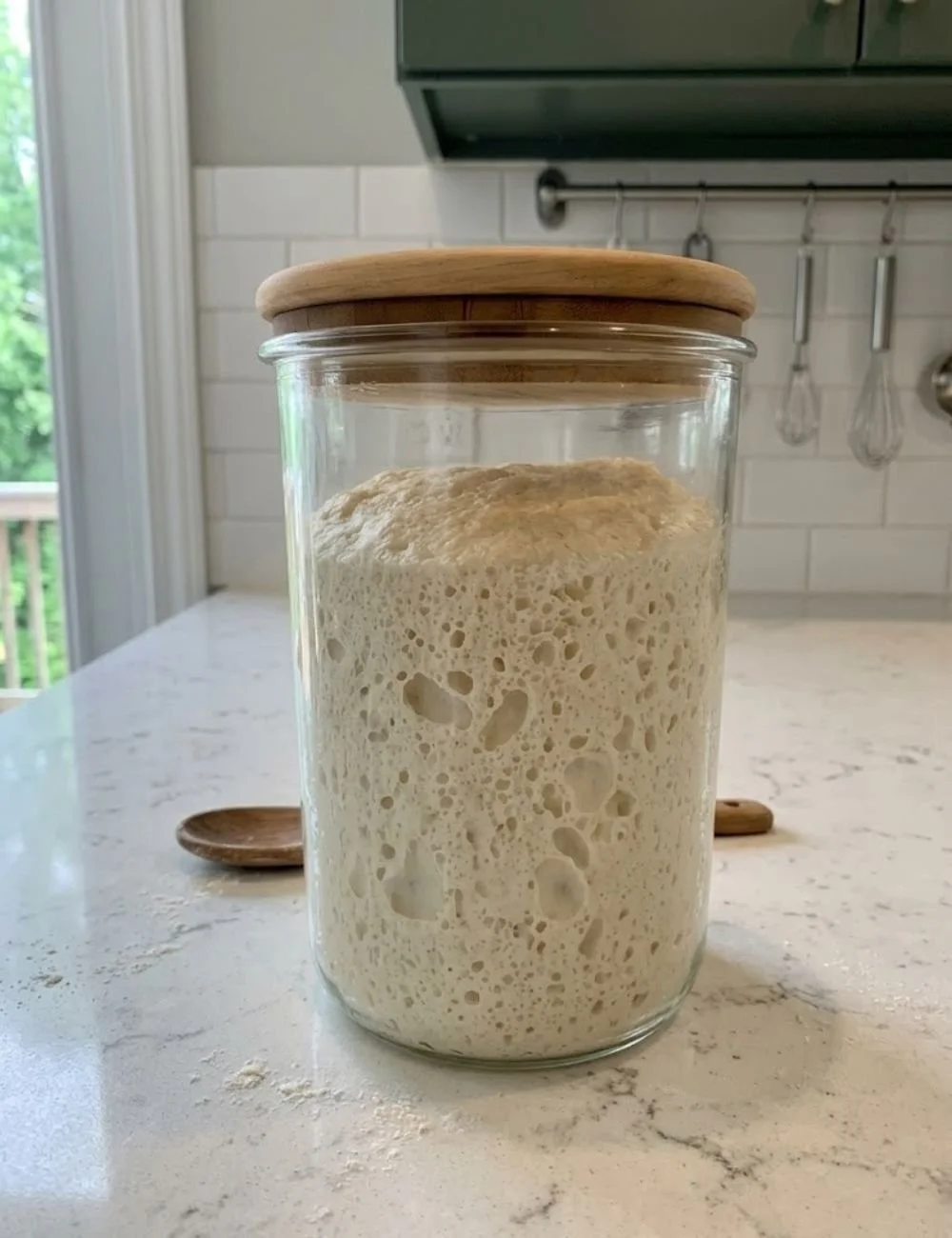
I switched my sourdough feeding ratio and everything changed. The starter woke up brighter, the crumb opened wider, and the loaf smelled deeply nutty and slightly tangy. If you bake with a sourdough starter, a small change in the feeding routine can affect rise, flavor, and timing. Below I show a practical feeding-and-baking routine that highlights why the ratio matters and how to use the stronger starter to make a reliably delicious boule. For a same-day, seeded option you might compare this to a faster method like the same-day sourdough boule with seeds.
Recipe Information
- Prep Time: 4 hours (includes starter feeding, autolyse, and bulk fermentation; 30 minutes active work)
- Cook Time: 45 minutes (bake time)
- Total Time: 4 hours 45 minutes
- Servings: 8 slices (one 900–1000 g loaf)
- Difficulty Level: Medium
Nutrition Information
Approximate per serving (one slice, 1/8 loaf)
- Calories per serving: 180 kcal
- Protein: 6 g
- Carbohydrates: 34 g
- Fat: 1.5 g
- Fiber: 2 g
- Sugar: 1 g
- Sodium: 160 mg
Why Make Why Changing My Sourdough Feeding Ratio Changed Everything
Adjusting your feeding ratio can shift your starter from slow and mild to lively and tang-forward. A higher fresh-flour ratio gives yeast more food and can speed ferment times. That shortens bulk fermentation and adds a lively aroma. You’ll notice a brighter sour note, a more open crumb, and stronger oven spring. This method helps home bakers hit reliable schedules and bake loaves that taste complex with less guesswork.
How to Make Why Changing My Sourdough Feeding Ratio Changed Everything
The goal is to use a fed, active starter that peaks predictably. I feed at a 1:2:2 (starter:water:flour) ratio the night before baking. That produces a vigorous starter in about 6–8 hours at room temp. Use that fed starter in a straightforward dough: autolyse, mix, bulk ferment, shape, proof, and bake. This routine balances flavor, timing, and crumb structure.
Ingredients:
- 100 g active sourdough starter (fed; see directions)
- 375 g water (75% hydration of flour)
- 500 g bread flour (or 450 g bread flour + 50 g whole wheat)
- 10 g fine sea salt
- Optional: 40 g seeds or nuts (sunflower, sesame, flax) for texture and flavor
Directions:
Step 1: Preparation
Feed your starter 6–8 hours before mixing dough. Use a 1:2:2 ratio (20 g starter : 40 g water : 40 g flour) or scale up so you have 100 g active starter for the recipe. Mix until lump-free and leave at room temperature. The starter should double and show bubbles when ready. Preheat your oven to 250°C (480°F) with a Dutch oven inside for at least 30 minutes before baking.
Step 2: Mixing
In a large bowl, combine 375 g water and 500 g flour. Mix until no dry flour remains and let rest for 30 minutes (autolyse). Add 100 g active starter and 10 g salt. Mix by folding or kneading lightly until the dough forms and passes a gentle windowpane test. If using seeds, fold them in during the last few turns.
Step 3: Cooking
Perform bulk fermentation at room temperature for about 3 hours, doing four sets of stretch-and-folds every 30 minutes in the first 2 hours. The dough should increase about 30–50% and feel airy and springy. Shape into a tight boule, place seam-side up in a floured proofing basket, and proof at room temp for 45–60 minutes, or refrigerate overnight for a milder flavor and easier schedule. To bake, score the loaf, place it seam-side down into the hot Dutch oven, cover, and bake 20 minutes covered at 250°C (480°F). Remove lid and reduce oven to 230°C (450°F) and bake 25 minutes more until deep golden and hollow-sounding.
Step 4: Finishing
Cool the loaf on a wire rack at least 1 hour before slicing. This finishing time lets steam escape and the crumb set. Slice and enjoy the crunchy crust, open crumb, and bright, slightly tangy flavor that comes from the stronger, well-fed starter.
How to Serve Why Changing My Sourdough Feeding Ratio Changed Everything
Serve slices warm with butter to highlight the tang and nutty aroma. The loaf pairs well with soups, ripe cheeses, or jam. For breakfasts, toast thick slices for a crunchy outside and chewy inside. For gatherings, cut into wedges and offer olive oil and balsamic for dipping.
How to Store Why Changing My Sourdough Feeding Ratio Changed Everything
- Short term: Store at room temperature wrapped in a clean tea towel or paper bag for 1–2 days to keep crust crisp.
- Medium term: For up to 5 days, store in a loose plastic bag at room temp to protect from drying.
- Long term: Slice and freeze in airtight bags for up to 3 months; toast or thaw slices directly from the freezer.
- Starter storage: Keep your starter in the fridge if you bake less often. Feed weekly and refresh before baking.
Expert Tips for Perfect Why Changing My Sourdough Feeding Ratio Changed Everything
- Use a digital scale. Weighing flour and water gives consistent results.
- Watch the starter, not the clock. Look for volume and bubbles as signs of readiness.
- Adjust room temperature. Cooler rooms slow fermentation; you may need longer bulk fermentation.
- Hydration tweaks: Reduce water by 10–20 g if dough feels too slack. Add up to 10 g more if too stiff.
- Sourdough flavor control: More frequent feedings and a higher ratio (1:3:3) create a milder starter; leaner feedings and room temp favor tangier flavor.
- Steam matters: Bake covered for the first 20 minutes to trap steam and improve oven spring.
- Use leftover discard creatively: pancakes, crackers, or quick flatbreads.
Delicious Variations
- Seeded boule: Add 40–60 g mixed seeds toasted for extra crunch and flavor.
- Whole wheat twist: Replace 100–150 g of bread flour with whole wheat for deeper flavor and denser crumb.
- Olive and rosemary: Fold in 60 g chopped olives and 1 tbsp chopped rosemary for a savory loaf.
- Rye boost: Replace 50–75 g flour with rye for a rustic, tangy loaf.
- Sweet touch: Add 30–40 g honey and 50 g raisins for a subtly sweet breakfast loaf (reduce water slightly).
Frequently Asked Questions
Q: What does 1:2:2 feeding ratio mean and why use it?
A: It means one part starter to two parts water and two parts flour by weight. This ratio refreshes the starter with plenty of food, encouraging strong yeast activity and predictable peak timing—helpful when you need a vigorous starter for baking.
Q: How do I know my starter is ready to use?
A: The starter should double in size, show lots of bubbles, have a pleasant tangy smell, and pass the float test (a spoonful floats in water). If it deflates quickly, it’s past peak.
Q: Can I use a refrigerated starter directly?
A: It’s best to feed and bring it to room temperature before using. A refrigerated starter is slow; feeding it 6–8 hours at room temp wakes the microbes and gives better rise.
Q: Will changing the feeding ratio change the flavor a lot?
A: Yes. Higher fresh-flour ratios lead to faster fermentation and a brighter, sharper sour. More frequent feedings and higher ratios make a milder loaf.
Q: How do I adjust timings if my kitchen is cold?
A: Expect slower fermentation. Increase bulk fermentation and proofing times. You can also place the dough in a slightly warm spot (oven with just the light on or near a warm appliance) to speed activity.
Q: What if my dough is sticky after autolyse?
A: Sticky dough is normal with higher hydration. Use wet hands for folding, and give it time—stretch-and-folds strengthen the gluten and reduce stickiness.
Q: Can I scale this recipe up or down?
A: Yes. Keep the same percentages: flour 100%, water 75%, starter 20% (based on flour weight), salt 2%. Scale weights accordingly.
Conclusion
Changing your sourdough feeding ratio is a small step with big results: livelier starter, clearer timing, and richer flavor. If you want a deeper dive into how different feeding ratios affect activity and taste, this guide on All you need to know about sourdough feeding ratios explains the science clearly. Try a 1:2:2 feed next time and notice how your loaf changes — then tweak to fit your schedule and taste. Happy baking!
Why Changing My Sourdough Feeding Ratio Changed Everything
Ingredients
- 100 g active sourdough starter (fed; see directions)
- 375 g water (75% hydration of flour)
- 500 g bread flour (or 450 g bread flour + 50 g whole wheat)
- 10 g fine sea salt
- Optional: 40 g seeds or nuts (sunflower, sesame, flax) for texture and flavor